Have you ever wondered what actually happens after a company approaches an investment bank? Do you know that every bank will respond? differently?
Imagine that you are the CFO of a multibillion-dollar company. You need an investment bank to manage the company’s assets, such as investing in other companies, hedging your equities, swapping some interest rate risk, etc. So, you approach a bank.
What happens after the bank has received your request? The answer depends entirely on which bank you are approaching and how they organize themselves internally. For customers like you, investment banks don't have a unified approach.

There are two mainstream structures: the Generalist Coverage Model and the Product Specialist Model. The first has you talking mainly to one person, with occasional meetings with specialists for specific questions. The second connects you to specialists for different assets from the start.
Generalist Coverage Model
The core of the Generalist Coverage Model is assigning one individual to manage the relationship and communication with the client, while many professionals behind this individual handle all product execution and most of the strategic planning. This individual acts as the sole bridge between the client and the bank, and is often called the Coverage Banker. Coverage Bankers are not professionals in managing every asset, but they need to understand the financial situation, goals, and risk tolerance of their client; determine which of the bank's capabilities can add value; connect their client to specialists of different assets as needed; and maintain communication between the client and the investment bank.
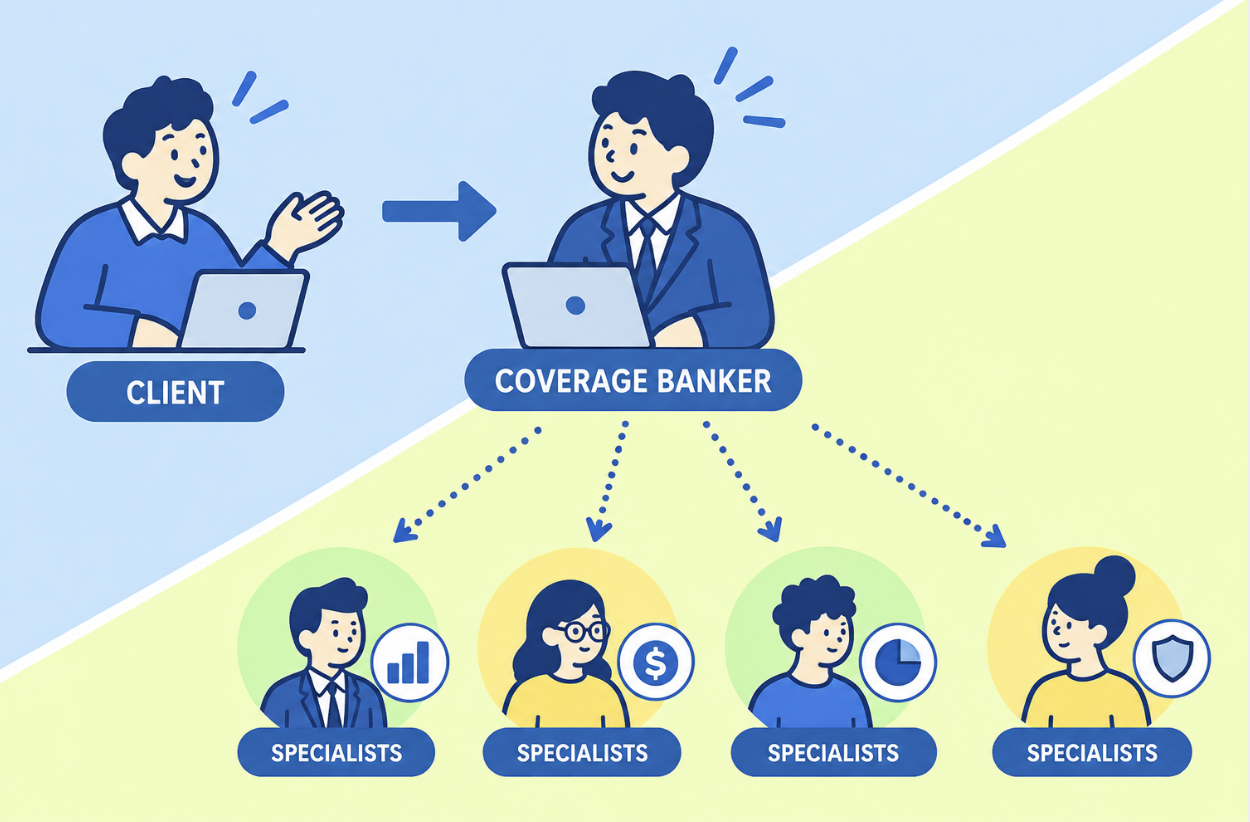
The benefit of this model is that the client doesn’t have to talk to many different specialists; all the key communications only need to go to the Coverage Banker, who will get back to the client with everything they need. This operation is similar to getting connected to a family doctor first, then being recommended to other specialized doctors.
Product Specialist Model
Simply put, the Product Specialist Model is applicable when the client knows what type of asset they want others to manage, so they can directly find relevant specialists. If a client is interested in equity derivatives, they find an equity derivative salesperson; if they are interested in interest rates, they reach out to an interest rate salesperson—in general, if they are interested in a specific sector (like energy), they contact a specialist in that sector. In this case, the bank organizes its services in terms of the types of assets, with specialists directly communicating with the client and each type of asset managing its own services.
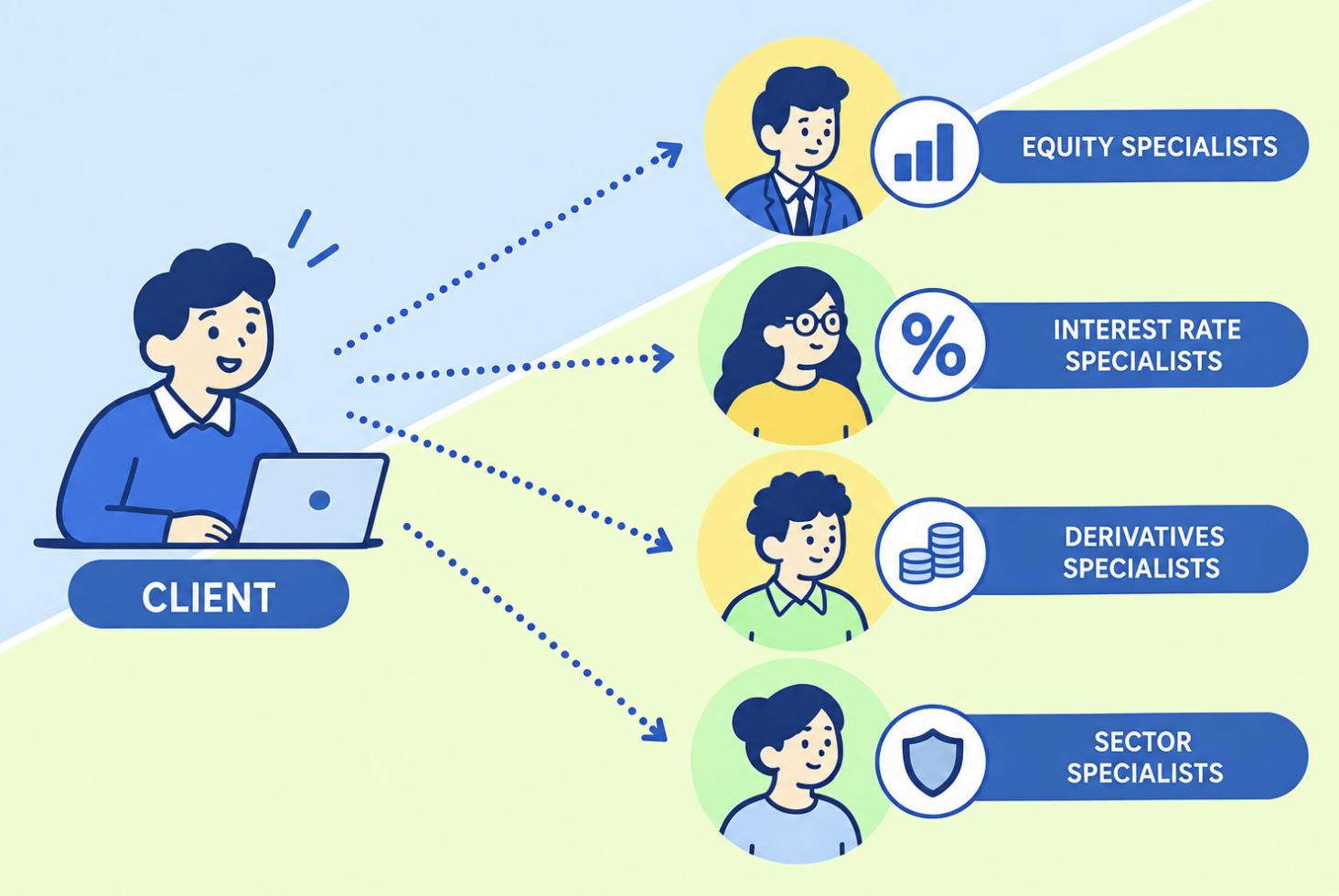
The Product Specialist Model mainly operates in a way similar to a“product line”. Using equity derivatives in the previous blog as an example, this “product line” includes: sales teams handling client communication and product recommendations, structures designing customized payoff profiles, traders managing pricing and risk, and a centralized research unit providing market insights.
This model is mainly designed for clients who have extensive knowledge of the product/asset, such as hedge funds and professional trading firms. These clients don't need someone like the Coverage Banker to translate their needs; they would like to see more details, like the accuracy of the option pricing models or other unique strengths. Therefore, the weakness of this model lies in the difficulty of coordination across different types of asset/product, as two trading desks may not be aware of each other's plans with the same client. This is why banks tend to adopt a hybrid model—so they can adapt to clients with different needs.
What is Actually Happening in Real Life
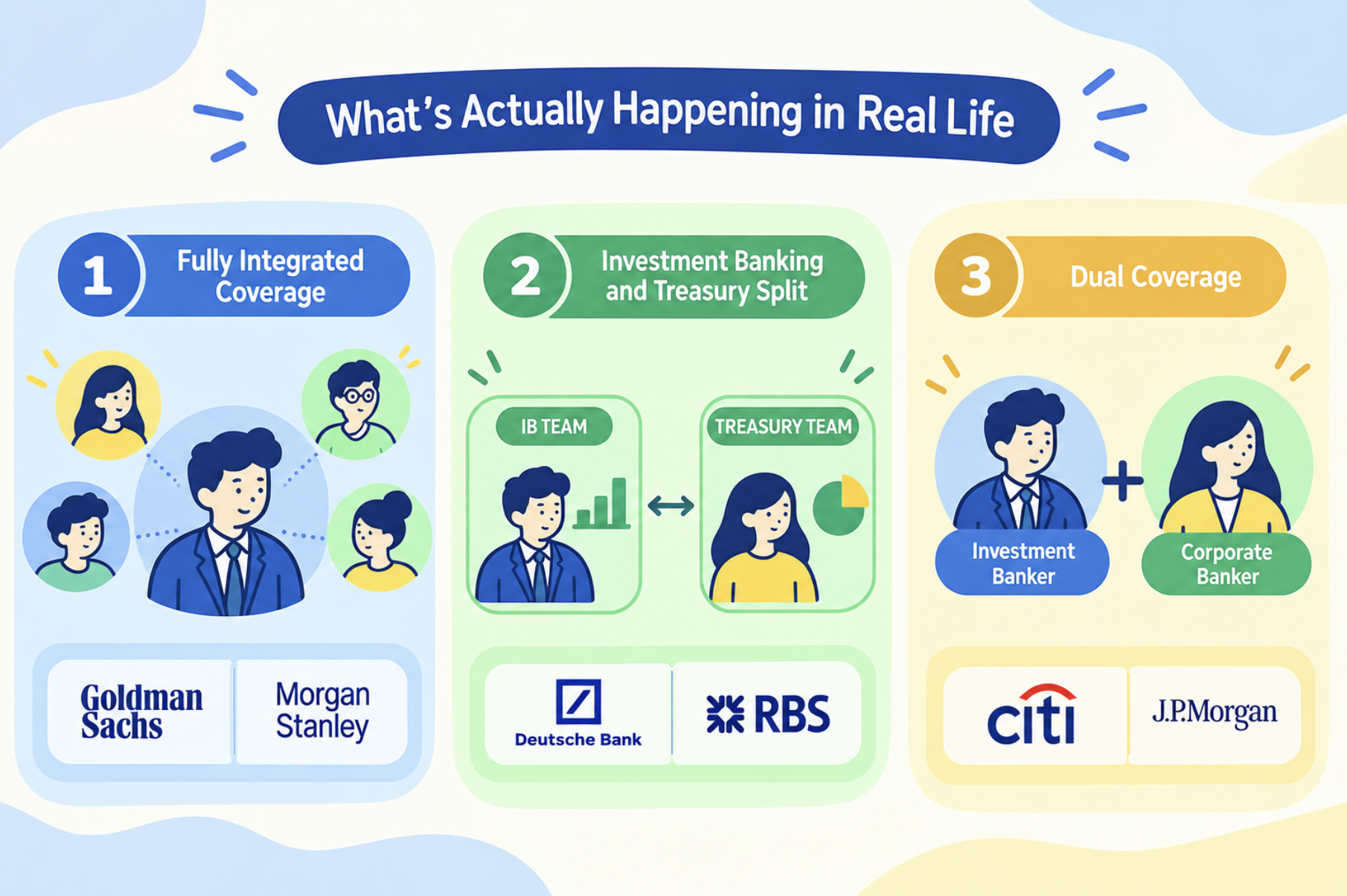
To be honest, there are barely any sources that can show how different banks actually operate; all we know is that banks mostly operate somewhere between the two models stated above. However, in Tricumen Bespoke Analysis of the Financial Market - Corporate Approach, three variations of operating are revealed, with real companies provided as examples.
The first is called Fully Integrated Coverage, which is the model employed by banks such as Goldman Sachs and Morgan Stanley. Under Fully Integrated Coverage, the bank selects a small group of profitable clients and serves them with a single coverage team. The specialists in different products/assets will work closely with the coverage team, which is mainly responsible for relationship building and communication with the client. This structure aims to provide an integrated, well-rounded service to the profitable clients and achieve high profit margins. Goldman Sachs' official blog confirms this idea, emphasizing "strength of the relationship with the client while expanding the physical presence of bankers to be closer to clients”.
The second variation is called Investment Banking and Treasury Split Coverage, represented by the German bank Deutsche Bank and RBS. This variation applies better to banks with a large multinational client base. Clients are covered by two teams: one is the investment bank, which can work on mergers and acquisitions (M&A), equity capital markets, etc and communicates with the CFO/CEO; the other is responsible for more specific assets, including high-grade derivatives, capital markets, treasuries, etc. These two teams coordinate regularly to ensure their planning around the same client is not contradictory to each other.
The last variation is called Dual Coverage, applied by Citigroup and J.P. Morgan. The main idea is to cover each client with both an Investment Banker and a Corporate Banker. The Investment Banker does the same things as the Investment Bank in the previous model but the Corporate Banker has a different role in assisting the client with borrowing debt, asset management, cash management, etc. This variation covers a larger client base, but requires more labour and heavy coordination efforts. In comparison to the previous ones, dual coverage can usually generate more revenue, but lower profit margins.
So, as a CFO, what happens after you call the bank depends on which door you walked through. Fully integrated coverage gives you one team that knows you well. Split coverage divides you between an IB banker and a treasury team. Dual Coverage assigns you both an investment banker and a corporate banker. There is no right or wrong structure; it really depends on your needs and goals.
Today’s blog is a special episode focusing on the bank’s structure rather than a specific career, which is something I personally wanted to write about, and thank you for reading.
Writing + Visuals by: Shannon Gao, Edited by: Rachael Zhou
