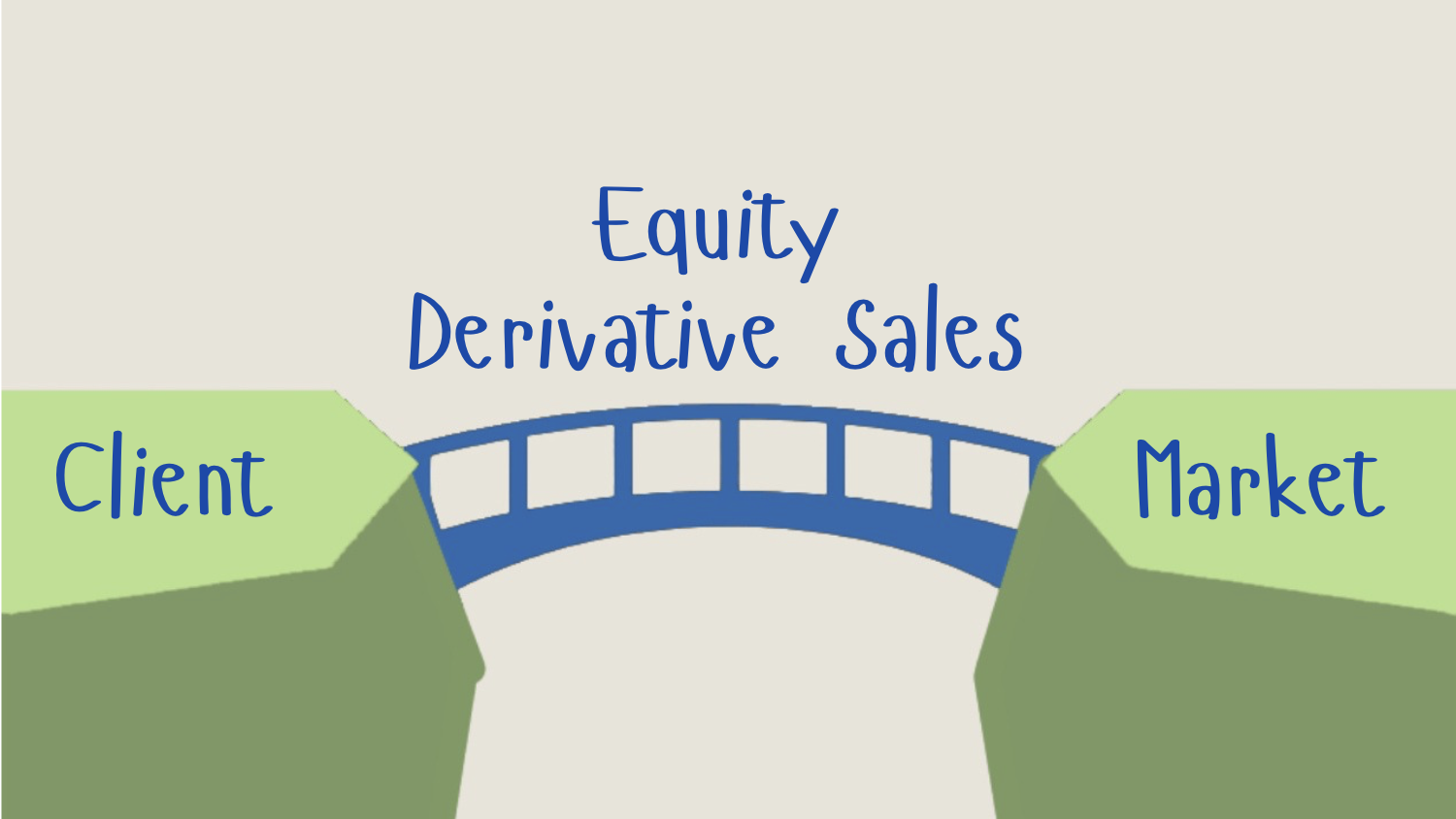
Equity Derivative Sales act as a bridge that connects the client’s world and the market’s world.
The clients know their goals, maybe protecting their current asset, maybe achieving a certain amount of growth, but they are not exactly sure how to get there. The market contains countless methods to achieve the client’s goal, including equity derivatives, which are extremely confusing.
What are Equity Derivatives
As the name suggests, equity derivatives can be broken down into two parts: equity and derivatives. Equity means assets such as stocks, ETFs, etc, and derivatives are contracts whose value moves up and down based on the performance of another asset. So, combining them, an equity derivative is a contract whose value depends on one or a group of stocks or an index. It’s important to note that you don’t actually own the stock if you buy an equity derivative; you just own a contract that pays you based on the performance of the stock.
Equity derivatives are mainly used for hedging (protecting themselves from losses), speculating (making money by betting on the future movement), arbitraging (profiting from price differences), and leverage (using a small amount of money to control a big position).
Main Types of Equity Derivatives
-
An option gives you the right to buy or sell a certain stock at a set price at a set time, but you will have to pay a fee called a premium for this right. There are 2 types of options: a call option that grants you the right to buy, and a put option that grants you the right to sell.
For example, if you think Apple’s stock (currently at $100 per share in October) will go up,you can use your option to buy Apple's stock at $110 in December. If Apple’s stock ended up rising to $150, you can sell it and gain profits. If Apple’s stock ended up going down, you let your option expire and just lose the premium you paid.
-
A binding agreement to buy or sell a stock at a specific price on a specific date in the future (this is binding; options are not).
For example, you sign a contract to buy 100 shares of Apple in 2 months, each at $120. If Apple’s price goes up to $150, you earn a lot of profit, but if Apple’s price goes down to $80, you lose a lot of money. Unlike options, you can’t withdraw anything.
Leverage is applied in futures, as you only need to put down a small amount of deposit to control a much bigger position, which also means you face significant loss or gain from very small price movements.
-
Swaps are similar to a bet. For example, you made an agreement with your friend that you will pay her whatever the return rate for Apple this year is and your friend will pay you a fixed 5% in return.
If Apple (assuming the stock is still at $100 per share) goes up by 8% this year, you pay your friend $3. If Apple goes up by 2% this year, your friend will pay you $3. If Apple goes down by 10%, your friend will pay you $15.
What Does This Job Do?
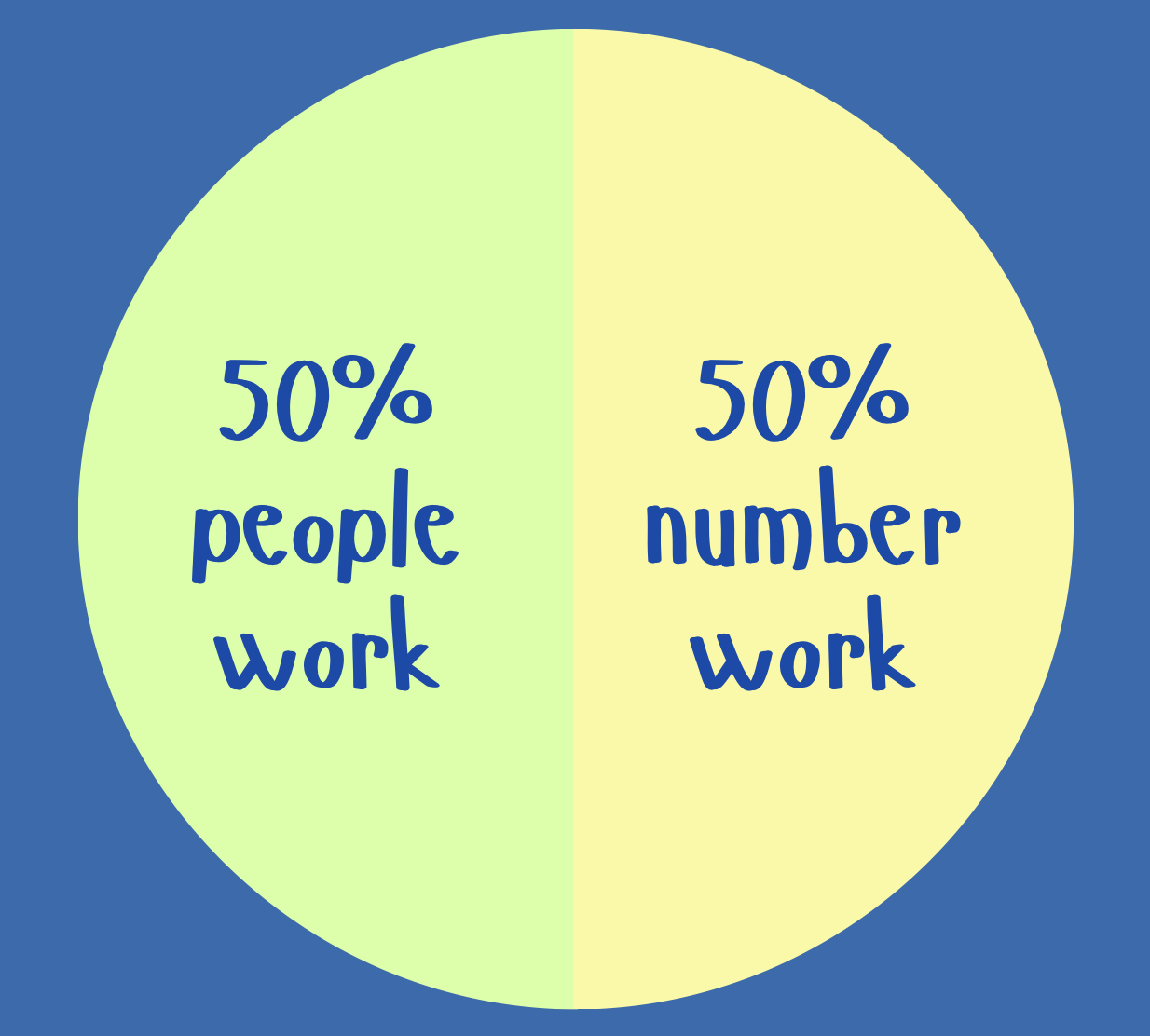
Equity derivative sales sit between the client and the trading desk. Clients often have some sort of goal, such as hedging a certain stock, customized swaps, etc. The role of equity derivative salespeople is to understand these goals, find the clients suitable equity derivatives, and make sure the trading desk executes these actions correctly. I was very lucky to hear from a professional who works as an equity derivative salesperson, who said their work consists of 50% “people” work and 50% “number” work.
In the “people” portion, the main purpose is to get the client to choose your company over others they are considering. Their work includes
Communicating with clients daily to understand their needs, communicate new updates, and explain complex products in equity derivatives in simple terms.
Coordinating with multiple departments to execute a trade, as a single trade might involve traders, structurers, legal, compliance, and operations.
Oftentimes, they need to maintain/build good relationships with the client, so it might involve dinners, concerts, and things the client wants help with.
In the number portion, the main purpose is to generate plans that incentivize the client to choose your company and oversee executing the plan. Their work includes:
Generating trading ideas depending on the market situations. For example, if volatility is low, suggest buying protection. If a client holds a large position in one stock, suggest a hedge. These ideas can get pitched to the client.
Turning a client’s want (for example, a put option for Microsoft at $400 in June 2027) into set numbers and requirements and send that to the trading desk for pricing calculations (such as how much the premium would be).
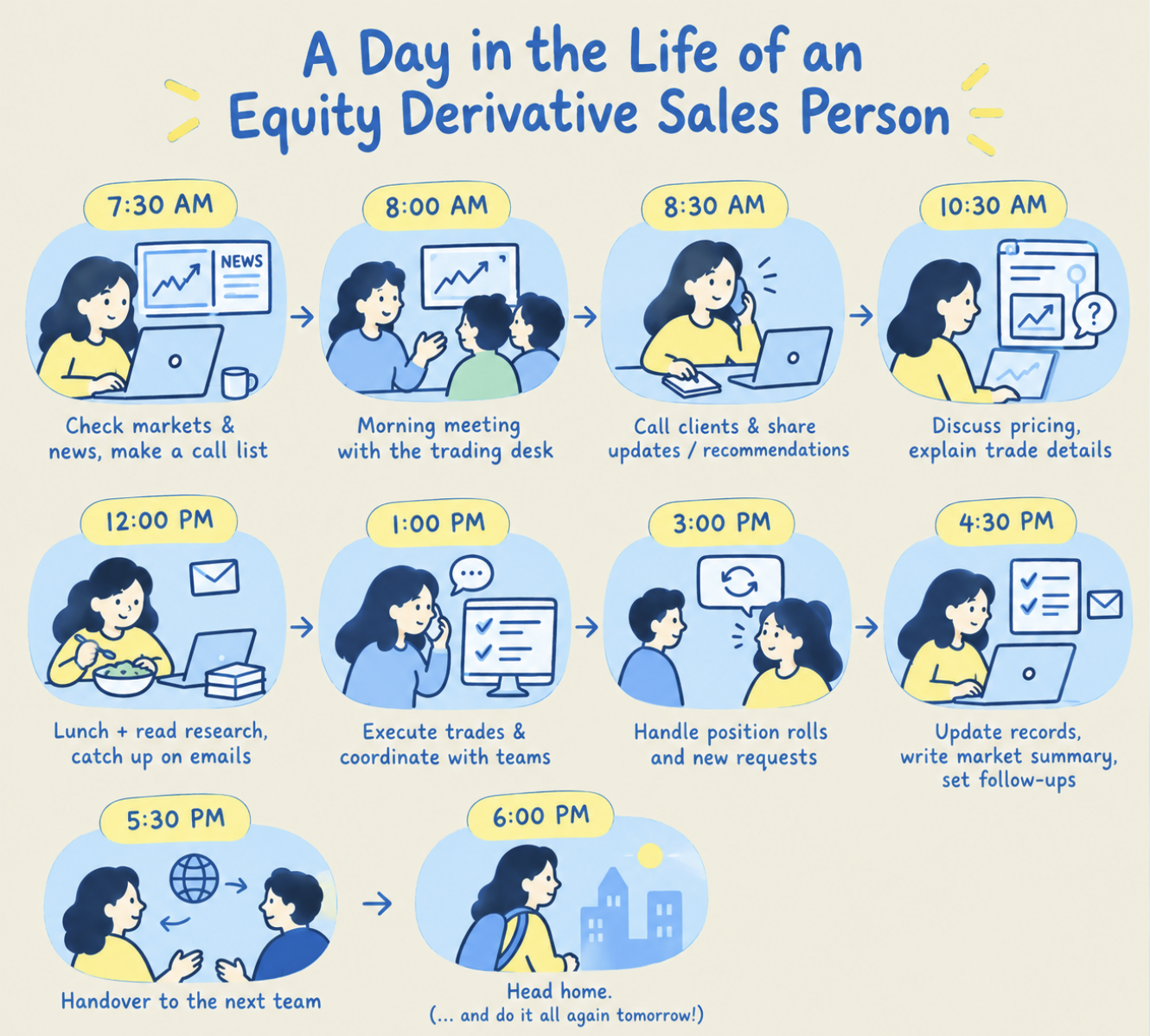
Day in the Life
Salary: Great Pay
For most sales jobs, including equity derivative sales, most job postings only show the base salary, which is only around 50% of the total pay. The other 50% are commonly bonuses depending on the number and specifics of each individual’s clients.
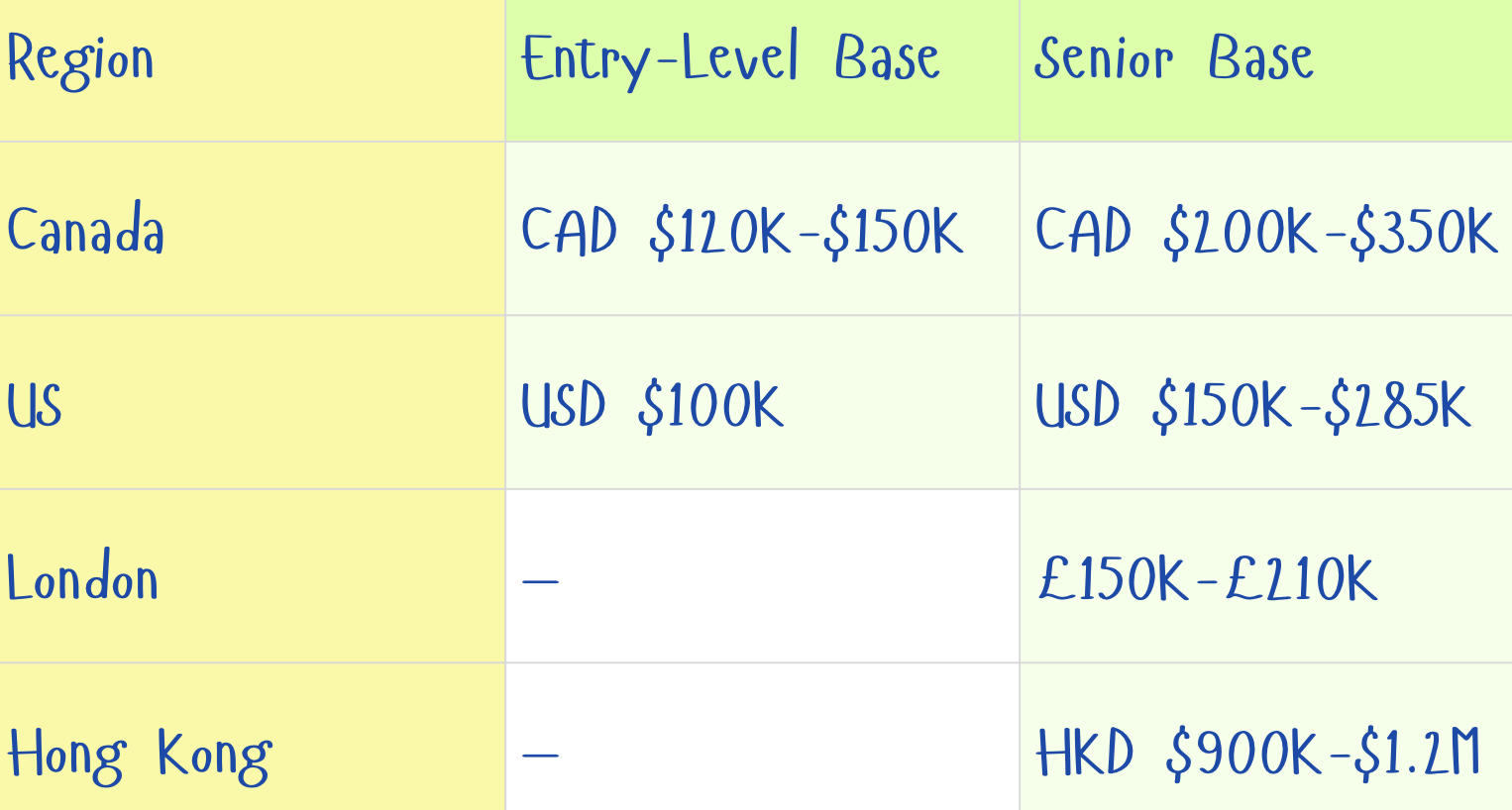
In Canada, according to the Glassdoor aggregate data, the average base salary for an entry-level role is around $120,000-$150,000 CAD, and the senior level’s base pay is commonly around $200,000-$350,000 CAD. These numbers can be supported by job postings such as Citi’s Corporate Derivative Salesperson (entry-level) at $120,000-$150,000, and BMO’s Associate Equity Derivative Sales roles with a $150,000-$200,000 CAD pay and 3-5 years of experience required.
In the States, entry-level roles with no experience required seem to have an average base pay of around $100,000 USD, which rises to around $150,000 after a few years as an associate. Then, with around 7 years of experience, their base salary can rise to $150,000-$285,000 as a vice president (VP) (according to job postings such as JPMorgan, BMO, etc.), which can result in total compensation potentially reaching $300,000-$500,000 depending on revenue generated by each individual’s client.
Overseas, in London the senior equity derivatives salesperson’s base salary is roughly £150K–£210K ($282,602-$395,643 CAD) , and in Hong Kong, the base salary appears to be $ 900,000- $ 1,200,000 HKD ($163,285 - $217,713 CAD), both with bonuses on top.
Employment Potential
Sanjay Jhamna, JPMorgan's global head of credit trading, said generative AI in the credit market will "reset who can compete and how they can compete" and that "winners and losers will be determined by how much companies embrace the opportunities from new technology". AI is being integrated more and more into derivatives workflows, with Citi publicly saying that generative AI can improve pricing, strategy development for OCT derivatives, summarize risk profiles, and help draft sales documents. From these examples, we can see that AI mainly serves to automate daily tasks. Many banks such as TD Securities, Goldman Sachs, etc have internal desks and copilots.
Moreover, an upward trend in the employment of this role is likely to be seen. Selby Jennings’ US 2026 report states that "Equity derivatives and cash equity desks are expected to remain active throughout 2026". This is then backed up by the fact that Montreal Exchange ETF Options ADV (a category of equity derivatives) rose by 98% in comparison to 2024.
Employment Difficulties
However, it is currently difficult to enter this job, especially at a junior level. Junior-level roles are scarce as companies often recruit professionals who already have established client relationships and can bring profit to the company immediately. VP-level roles are also very saturated unless it is a promotional step. Firms are commonly looking for at least 3 months of internship experience, a strong understanding of derivatives, communication skills, analytical skills, and some basic level coding skills, a trend that has just started to develop in recent years with the rise of technology.
Favoured Education
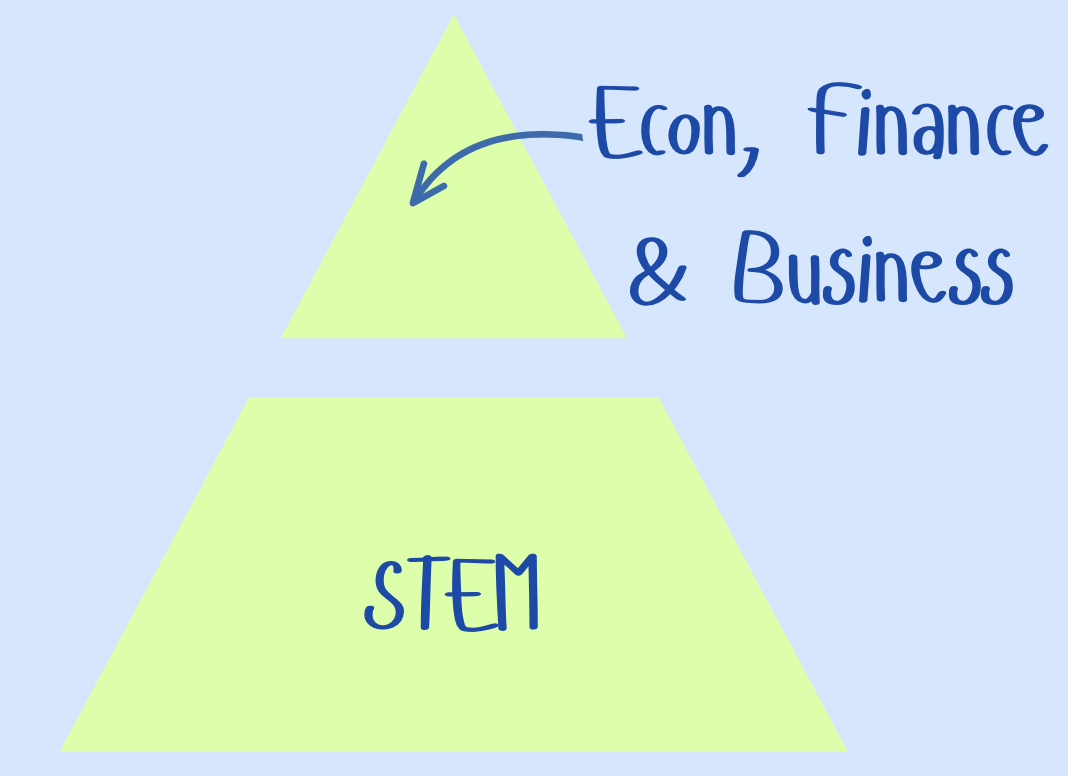
The minimum requirement for all equity derivatives sales related roles is a bachelor’s degree, which tends to be in finance, economics, business, and sometimes in STEM. Finance, economics, and business majors seem to be the most direct path, with postings from Citi, and TD all listing these degrees as requirements or strong preferences. STEM majors such as mathematics, computer science, and engineering tend to be okay, but not favoured as much as the previous roles, given that the analytical aspect of this role isn’t very heavy.
High School Recommendations
-
The first recommended action is to take courses such as Calculus, Statistics, Economics (both Micro and Macro), Accounting, Introduction to Business, Business Leadership, etc.
-
Secondly, participate in investment and business-related competitions such as the Wharton Global High School Investment Competition (aka WGHS Investment Competition) (the most prestigious investment competition globally), DECA (North America only), FBLA (North America only), etc. I personally find the time and performance pressure in competitions extremely helpful for me to learn a large amount of knowledge in a short period of time while applying it immediately in the competitions. Especially, WGHS Investment Competition’s format is very similar to the responsibility of equity derivative sales, as both require you to allocate a set amount of money into different assets. However, the single downside is that equity derivatives are often one of the most complicated investment methods , so they are not included in any investment competitions , although practicing the general investment process and structure is extremely helpful.
-
Lastly, it is highly recommended, even to university students, to follow market news to understand what is moving the market and what actions firms commonly take. As easy as this one sounds, it takes a certain amount of perseverance to build up this habit.
Women’s Underrepresentation
For women generally, representation drops sharply in middle and senior management. TD Bank has set a goal to reach 45% women in VP and above roles in Canada by 2025, acknowledging that diverse representation is higher in junior roles than senior ones. Additionally, they often uplift each other, as one senior woman in equity derivatives sales at Société Générale described mentorship as central to her career progress.
Writing + Visuals by: Shannon Gao, Edited by: Rachael Zhou
